Block paving patterns and colours

Every pattern, border and finish we lay, shown on a typical Bristol driveway. Pick the ones you like and we'll talk them through at your free survey.

At a glance

Best for
Driveways, paths and patios
Drainage
Falls to a channel or soakaway, or permeable blocks that drain through the joints
Repairs
Single blocks lift out and go back without a patch
Upkeep
Sweep, weed the joints and top up the jointing sand now and then

Laying patterns

The pattern decides how the blocks lock together as much as how the drive looks. Interlocking patterns cope best with cars turning and braking. Each diagram shows the pattern on its own, with an edging course along the bottom.

9 options

90° herringbone

Blocks laid in pairs at right angles, forming a zig-zag that runs parallel to the edge course.

Blocks lock together in both directions, so it is widely recommended for driveways.

45° herringbone

The same right-angled pairs, with the whole pattern turned to 45° against the edge.

The same strong interlock as 90°, with a more dynamic diagonal look. Needs more cut blocks at the edges.

Stretcher bond

Parallel rows of blocks, with each row offset by half a block.

A classic, tidy look. On driveways it is usually laid with the rows running across the direction of travel.

Stretcher bond, lengthways

Stretcher bond turned so the rows run the length of the area, which makes a narrow path or drive look longer.

45° stretcher bond

Half-offset rows of blocks running diagonally across the paved area.

Stack bond

Blocks aligned directly above one another, with continuous straight joints in both directions.

A clean, modern grid. The continuous joints suit paths and patios better than busy driveways.

45° stack bond

The same aligned grid, turned to 45° so the continuous joints run diagonally.

Basketweave

Pairs of blocks alternate direction to create a traditional woven effect.

A decorative pattern that works well on paths, patios and feature areas.

Contrasting basketweave

Basketweave in two colours, so the alternating pairs read as a checkerboard.

Headers and bands

A contrasting header course frames the drive and gives the edge a crisp finish. A band across the middle breaks up a large area.

6 options

Stretcher bond with contrasting headers

Stretcher bond framed top and bottom by a contrasting header course laid across the edge.

Stretcher bond with band and headers

Contrasting headers at each edge with a matching band across the middle.

45° herringbone with contrasting header

Diagonal herringbone finished with a wide contrasting header course along the edge.

45° herringbone with band

Diagonal herringbone split by a narrow contrasting band.

45° stack bond with band

A diagonal stack bond grid crossed by a straight contrasting band.

45° stack bond with diagonal band

A contrasting band runs corner to corner, following the line of the diagonal grid.

Feature details

Inlays, curves and circles turn a plain drive into a centrepiece. They can be combined with most of the patterns above.

5 options

Diamond inlay

A single contrasting diamond outline adds a focal point within the paving.

Double diamond inlay

Two nested contrasting diamond outlines form a feature within the paving.

Triangular inlay border

Contrasting triangles set along the edge, with an outer header course.

Curved contrasting border

Small blocks follow a curve to form a rounded contrasting edge around the main paving.

Circle feature

Concentric rings of buff and grey blocks create a circular feature within the main paving.

Block finishes and colours

Tumbled blocks give an aged, traditional look; smooth and aggregate faces suit modern homes. Permeable blocks let rainwater drain through the joints.

7 options

Aged grey blocks

Aged grey concrete blocks with softly distressed edges and a traditional mixed-size layout.

Warm buff blocks

A warm blend of buff, beige and honey tones, with gently aged concrete edges.

Autumn blend blocks

Muted copper, red, buff and earthy grey tones combine in an aged concrete block finish.

Traditional brown blocks

Earthy brown and charcoal tones give mixed-size concrete blocks a traditional finish.

Silver aggregate blocks

Light silver concrete blocks with a fine granite aggregate face and dark edging.

Graphite aggregate blocks

Dark graphite concrete blocks with fine visible aggregate and contrasting silver edging.

Permeable brindle blocks

Red and charcoal concrete blocks with aggregate-filled joints, illustrating a permeable paving finish.

Block ranges

We are approved installers for Marshalls, Tobermore and Brett. These are three popular ranges; each comes in its own block sizes and colours.

3 options

Marshalls Drivesett Tegula

Tumbled blocks with an aged, traditional finish. Colours include Traditional, Pennant Grey, Harvest, Charcoal, Autumn and Hazelnut.

Shown in Harvest.

Photo and details: Marshalls

Tobermore Sienna

Blocks with a granite aggregate face for a crisp, modern look. Colours: Graphite, Mid Grey and Silver.

Shown in Graphite.

Photo and details: Tobermore

Brett Alpha Flow

Tumbled permeable blocks with spacer nibs that keep the joints open, so rainwater drains straight through. Colours: Autumn Gold, Brindle and Charcoal.

Shown in Brindle.

Photo and details: Brett

Standard or permeable block paving

Both look alike from above. The difference is where the rain goes, and that decides what sits underneath.

Standard block pavingPermeable block paving
Where rain goesRuns off the surface to a channel drain or soakawayDrains through open joints into the stone below
JointsKiln-dried sand, brushed in tightSmall stone chippings, kept open
UnderneathSand laying course on a compacted stone sub-baseStone bedding on an open-graded stone sub-base
Front gardensOver 5 m², the water must run to a permeable area or a soakawayDrains on-site, which keeps it inside permitted development
UpkeepTop up the jointing sand every few yearsKeep the joints clear and top up the chippings

How it's built

The layers under the surface matter as much as the finish. Depths, drainage and reinforcement are set for each site at the survey.

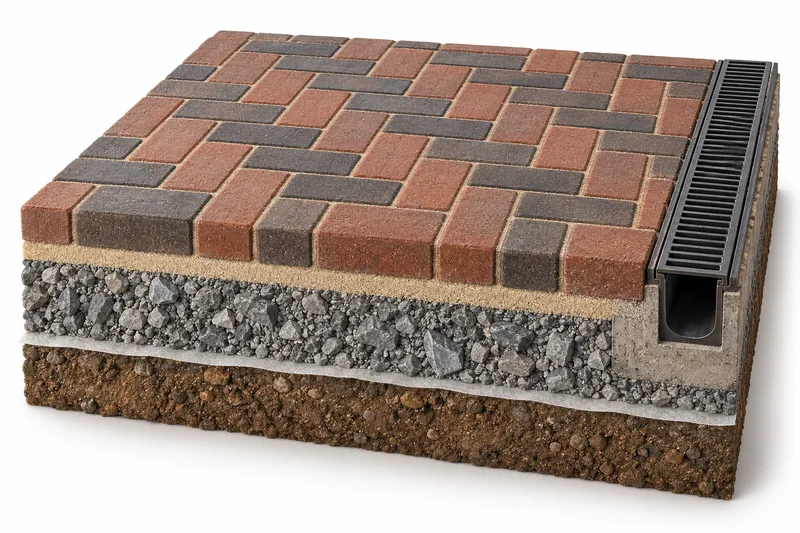
Standard block paving, illustration of the layers

Standard block paving

The blocks are bedded and jointed with sand, and the surface is laid to fall towards a channel drain. The channel outlet, the falls and the edge restraint are designed for each site.

  1. Concrete blocks with sand-filled joints
  2. Sharp sand laying course
  3. Compacted stone sub-base
  4. Geotextile membrane
  5. Prepared ground
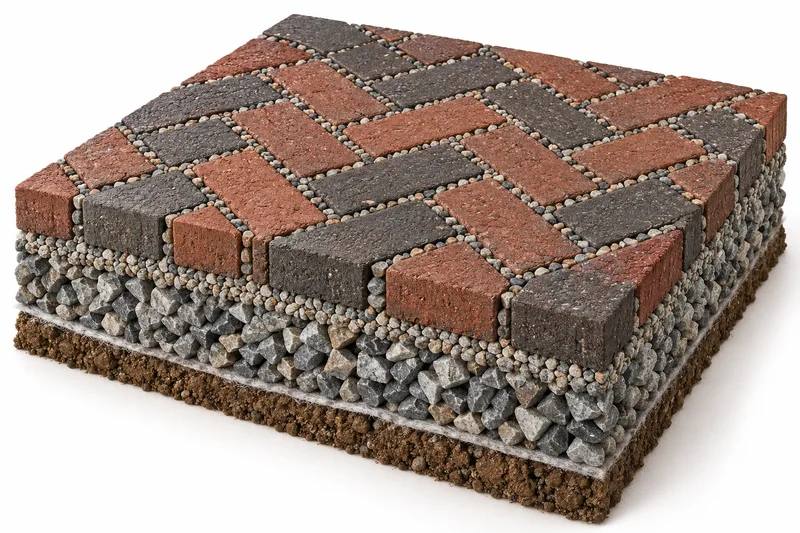
Permeable block paving, illustration of the layers

Permeable block paving

Stone-filled joints let rain straight through into an open-graded stone foundation, where it soaks away. How well it drains depends on the ground, so we check it at the survey.

  1. Permeable blocks with stone-filled joints
  2. Fine stone bedding layer
  3. Open-graded stone sub-base
  4. Geotextile membrane
  5. Prepared ground

Illustrations, not to scale. Layer depths and drainage are designed for each site.

Choosing well

A few things we talk through at every survey.

  1. Choose the pattern for the traffic

    Herringbone locks together best under turning cars. Stretcher bond and basketweave suit paths, patios and lighter use.

  2. Match the colour to the house

    Brindles and reds sit well with brick; buffs and greys suit render and Bath stone. Look at samples next to your walls, not on a screen.

  3. Frame it with a border

    A contrasting header course gives the edge a crisp line and hides the cut blocks along it.

  4. Plan the drainage first

    On a front garden, decide between permeable blocks and a channel drain early, because it changes what goes underneath.

FAQ

Questions

Which block paving pattern is best for a driveway?

Herringbone, at 90° or 45°, is the usual choice for driveways because the blocks lock together in both directions and resist movement from turning and braking cars. Stretcher bond also works when the rows run across the direction of travel.

Can I combine a pattern with a border or an inlay?

Yes. Borders, bands and inlays can be added to most patterns, and contrasting colours can be mixed. We go through the options with you at the free survey.

Are these photos of driveways you have laid?

No. The patterns are drawn as diagrams and the finishes are illustrations, made to show each option clearly. The block range photos come from the manufacturers. Photos of real driveways we have laid are in our recent work.

Can a damaged block be replaced on its own?

Yes. A stained or broken block can be lifted out and replaced without disturbing the rest of the drive, which is one of the main advantages of block paving.

Get a free driveway quote in Bristol.

Free site visit, free written quote, no obligation. Smart Paving Bristol covers driveways, patios and paving across Bristol and South Gloucestershire. Booking your free survey takes under a minute.