Resin bound colours and finishes

Every resin bound colour blend we lay, the two stone sizes, and how resin bound differs from resin bonded. Compare them before your free survey.

At a glance

Best for
Driveways, paths and patios
Surface
Smooth and joint-free, with every stone coated in resin
Drainage
Porous, so it drains through when the base below is permeable too
Upkeep
Sweep regularly and jet wash now and then on a low setting

Warm blends

Honey, gold and bronze tones suit Bath stone, red brick and traditional homes.

5 options

Autumn Quartz

A blend of honey, amber and gold rounded quartz.

Golden Pea

Warm golden rounded pea gravel with a soft, natural look.

Brittany Bronze

Bronze, rust and gold stones mixed for a rich, earthy finish.

C50 Sand

A pale sandy beige blend of fine aggregate.

Beige

Light beige and cream stones for a soft, bright surface.

Light and neutral

Pale and grey blends brighten a frontage and suit modern and rendered homes.

2 options

White Flint

White and pale grey angular flint for a crisp, bright finish.

Silver

Silver grey granite chips with a clean, contemporary look.

Dark and bold

Strong colours make a statement and hide everyday marks well.

4 options

Black

Black basalt chips for a sleek, modern surface.

Red

Red granite chips for a warm, bold finish.

Rose Pink

Soft pink granite for a gentle, warm tone.

Green

Green and grey granite, often used for paths and garden features.

Natural stone blends

Blends of natural stone in a wider range of colours. Enlarge a sample to see a finished driveway in that blend.

28 options

Amalfi

Pale golden and cream stones.

Anthracite

Dark charcoal, grey and black stones with lighter flecks.

Aspen

Light off-white tones with warm grey highlights.

Cappuccino

Warm cream and coffee-brown tones with darker flecks.

Cedarwood

Warm brown and rust tones with grey and pale stones.

Cotswold

Golden beige tones with contrasting darker stones.

Dorset Cove

Warm brown and pinkish tones with pale highlights.

Dove Grey

Pale grey tones with light marble highlights.

Evening Rose

Warm red-brown and amber tones.

Farmhouse Gold

Rich brown and golden stones with darker accents.

Graphite

Charcoal-grey tones with lighter grey flecks.

Grey Slate

Mixed grey stones with darker slate-like tones.

Honeycomb

Amber and golden stones with darker charcoal flecks.

Ireland Green

Green-grey tones with pale and warm contrasting stones.

Jet Black

A deep black finish with subtle reflective highlights.

Levana

A balanced mix of grey, white and darker stones.

Meadow

Warm honey-gold and buff tones.

Mercury

Silver-grey tones with occasional warm highlights.

Olympus

Golden-brown stones mixed with cream highlights.

Oyster Pearl

Pale cream and white tones with subtle grey highlights.

Platinum

A crisp mix of white, grey and dark stones.

Purity

Pale stones with golden and brown accents.

Sahara

Warm sand and golden tones with pale highlights.

Sorrento

Soft pale-grey and cream tones.

Spring Haze

Light golden tones mixed with pale cream stones.

Sweet Pea

Rounded brown and golden stones with darker flecks.

Transcendence

Rust-red, gold and pale contrasting stones.

Verona

A mix of mid-grey and darker stones with pale highlights.

Stone size

Most blends come in two stone sizes. The size changes the texture underfoot more than the colour.

2 options

1-3 mm

Smaller stones give a smoother, finer surface, popular for patios and paths.

Shown in Autumn Quartz.

2-5 mm

Larger stones give more texture and grip, a common choice for driveways.

Shown in Autumn Quartz.

Resin bound or resin bonded

The two names sound alike but give very different surfaces.

2 options

Resin bound

Stones are fully mixed with resin and trowelled smooth, giving a smooth, joint-free surface that water can pass through.

Smooth, porous and comfortable underfoot. This is what we lay for driveways.

Resin bonded

A layer of resin is spread on the base and loose stones are scattered on top, leaving a rougher, gravel-like texture.

Not porous, and loose stones can come away over time.

Resin bound or resin bonded

The names are close, but one is a mixed stone layer and the other is loose stone stuck to the top.

Resin boundResin bonded
How it is madeStone and resin mixed together and trowelled smoothResin spread on the base and loose stone scattered on top
Feel underfootSmooth and evenRough, like gravel
RainDrains through the surfaceRuns off the surface
Loose stonesNone, every stone is coatedSome come away over time
Typical useDriveways, paths and patiosLight-use areas and decorative strips

How it's built

The layers under the surface matter as much as the finish. Depths, drainage and reinforcement are set for each site at the survey.

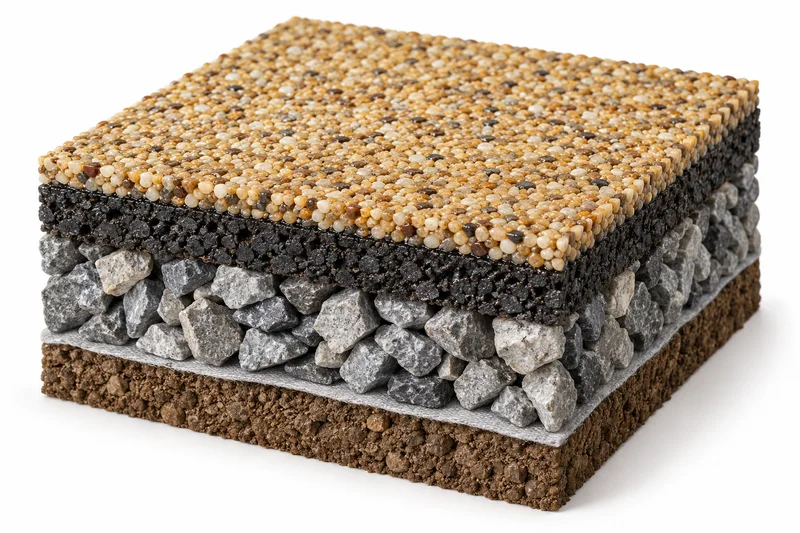
Resin bound on a permeable base, illustration of the layers

Resin bound on a permeable base

Coated stones form a continuous, open-textured layer on a porous asphalt base, so rain passes through the whole build-up and soaks away below.

  1. Resin bound stone layer
  2. Porous asphalt base
  3. Open-graded stone sub-base
  4. Geotextile membrane
  5. Prepared ground
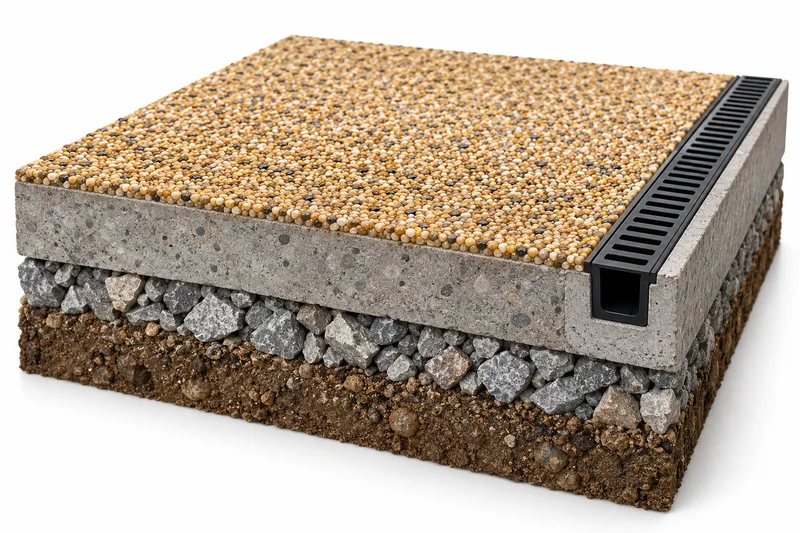
Resin bound over a dense base, illustration of the layers

Resin bound over a dense base

Laid over sound concrete or tarmac, the resin layer is still porous, but the base below is not. Rain is led to a channel drain or soakaway instead, so a porous top alone does not make the whole drive permeable.

  1. Resin bound stone layer
  2. Dense concrete or tarmac base
  3. Compacted stone sub-base
  4. Prepared ground
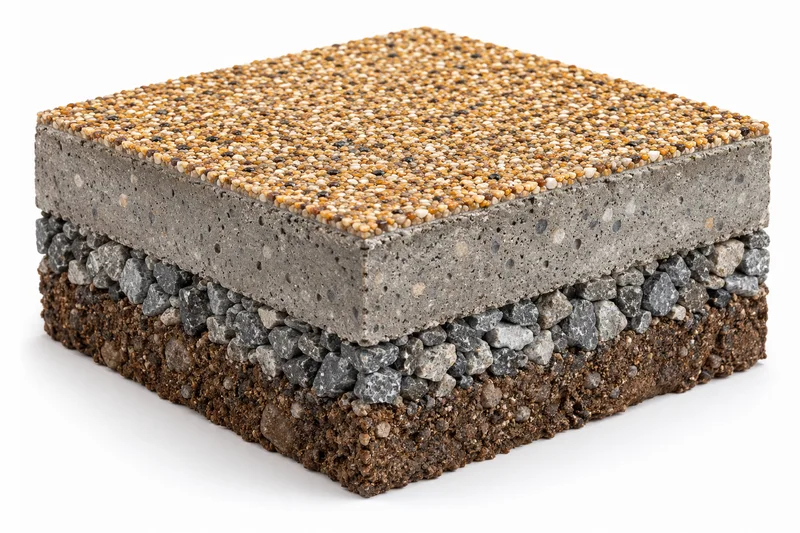
Resin bonded, illustration of the layers

Resin bonded

A thin dressing of loose stone on a film of resin over a dense base. It looks like gravel but is a different, non-porous surface.

  1. Stone dressing on a resin film
  2. Dense base
  3. Compacted stone sub-base
  4. Prepared ground

Illustrations, not to scale. Layer depths and drainage are designed for each site.

Choosing well

A few things we talk through at every survey.

  1. Check the base first

    A sound tarmac or concrete base can sometimes be reused. A cracked or uneven one has to be fixed first, or the cracks come through.

  2. Use UV-stable resin for pale blends

    Light colours need a UV-stable resin so they do not yellow in the sun.

  3. Pick the stone size for the job

    1-3 mm gives a finer finish for paths and patios; 2-5 mm has more grip and texture for driveways.

  4. See a sample in daylight

    Blends look different indoors, in shade and when wet. Look at a real sample outside before you decide.

FAQ

Questions

Is a resin bound driveway permeable?

Resin bound surfacing is porous, so water can pass through it. Whether the whole driveway drains properly depends on the base underneath and where the water goes, so we check drainage and planning for your property at the survey.

Can resin be laid over my existing drive?

Sometimes. A sound, level tarmac or concrete base can be reused, but a cracked or uneven one has to be repaired or replaced first. We assess the existing surface at the free survey.

Will a light colour turn yellow?

Light blends need a UV-stable resin to keep their colour in sunlight. Ask which resin is being used before you choose a pale colour.

Are these photos of driveways you have laid?

No. The colour swatches in the first sections are illustrations made to show each option clearly. The natural stone blends are shown as real stone samples with example driveways. Photos of real driveways we have laid are in our recent work.

Get a free driveway quote in Bristol.

Free site visit, free written quote, no obligation. Smart Paving Bristol covers driveways, patios and paving across Bristol and South Gloucestershire. Booking your free survey takes under a minute.